No need to sample

Yesterday I did some initial exploration of Jev. I tried a few use cases and was impressed by all of them except chess, which it played terribly, at least under my harness. But I wanted to try what I think is the killer use case: judging LLM output.
Alongside programmatic checks, it’s common to use one LLM to judge the output of another. That comes with two constraints. A judge call adds seconds, so you run it after the fact, which is fine for a slow feedback loop and bad for catching a mistake as it happens. And a judge call is relatively expensive, so you score a few percent of outputs and assume the rest look like the sample. Basic economics.
In this post, I take a Haiku judge I’d already built and run, a reachability check on generated game levels, and point Jev at the same dataset. It’s fast, it’s dirt cheap, and it mostly agrees with Haiku.
I think the economics just changed.
When you can judge everything
Jev obliterates both constraints. It can score a piece of content on multiple dimensions in a quarter of a second for a fraction of a cent. At that price there is no reason to sample. At that latency you can do it before sending the result to a user.
This is not an original idea. TypeSafe is pretty clear that this is what they built Jev for. They even named the model after the economist who noticed that making something cheaper tends to mean you use far more of it.
Jev is well suited to use cases that require clear judgment calls about a piece of content. Does every claim in this answer have a citation? Does every citation point at a real source? Does this summary introduce a number that wasn’t in the source material?
It is also competent at use cases where semantic meaning matters and the judgment is fuzzier. Is the tone right for a customer who is already angry? Does this response answer the question or restate it? Is this within policy, or does it need a human?
It does take some design work. My first attempt was a straight port of an old six-criterion rubric, and the scores came back compressed: the same rankings as the original judge, but with much less spread. I’d bet that’s a me problem. Narrow questions with explicit criteria are what Jev is built for, and a rubric written for a generative judge isn’t that. It’s a different skill, and I’m still learning it.
The pattern is simple. Judge every important generation inline. Act when confidence is high, escalate when it isn’t. Catch mistakes early.
The numbers
I had a dataset from another experiment I ran a while ago. I was exploring the impact of schema design on structured output (my favorite topic lately). I had an LLM generate level configs for a fake game using six schema variants ranging from intentionally confounding to hopefully optimal. It included two types of judgments: a Likert-style score on six dimensions that tried to measure how good the level was and a more mechanical check on whether the end of the level was reachable.
I converted these judgments to a Jev Score and Noul respectively. Here is how they compare to the original Haiku results (n=64 levels per variant, three encounters each):
| Variant | Original Likert | Jev Likert | Original break % | Jev break % |
|---|---|---|---|---|
| flat_alpha | 3.84 | 4.46 | 5.2 | 3.6 |
| alpha_nested | 3.84 | 4.47 | 4.2 | 2.6 |
| ui_contract | 3.89 | 4.56 | 1.0 | 1.0 |
| append_order | 4.18 | 4.55 | 8.9 | 7.8 |
| grouped_by_type | 4.18 | 4.62 | 1.6 | 1.0 |
| nested_narrative | 4.32 | 4.64 | 0.0 | 0.0 |
Both judges rank the variants the same way, with nested_narrative clean and append_order breaking most often.
On the Likert-style rubric, Jev was more lenient and compressed. Zooming in, the two judges did have a positive Spearman coefficient (0.58 on the weighted total), so they generally ranked them similarly. In a real world scenario, I could try moving my threshold, but I think I’d redesign the rubric in this case.
The break percentage measures how many levels are not logically completable. These line up closely, with Jev a little more lenient on most variants. I was curious about where it differed, so I compared each and grouped them by what happened:
| Category | Verdict | Jev confidence | n |
|---|---|---|---|
| semantic match | Jev more accurate - Haiku missed it reading literally | 0.71–0.96 | 6 |
| plausible inference | debatable | 0.60–0.83 | 3 |
| semantic overreach | Haiku more accurate - Jev too generous | 0.50–0.67 | 2 |
The two calls Jev got wrong are also the two it was least sure about. Everything defensible starts at 0.71. That’s the threshold behavior you’d want from a gate, and it’s why this felt natural to use for this kind of check.
I then reran the full set 9 more times. Variant means held to within 0.006, though individual scores did move between runs (mean spread 0.11 on a 0–4 scale). It’s stable in aggregate, but not per item. The reruns also gave me latency numbers:
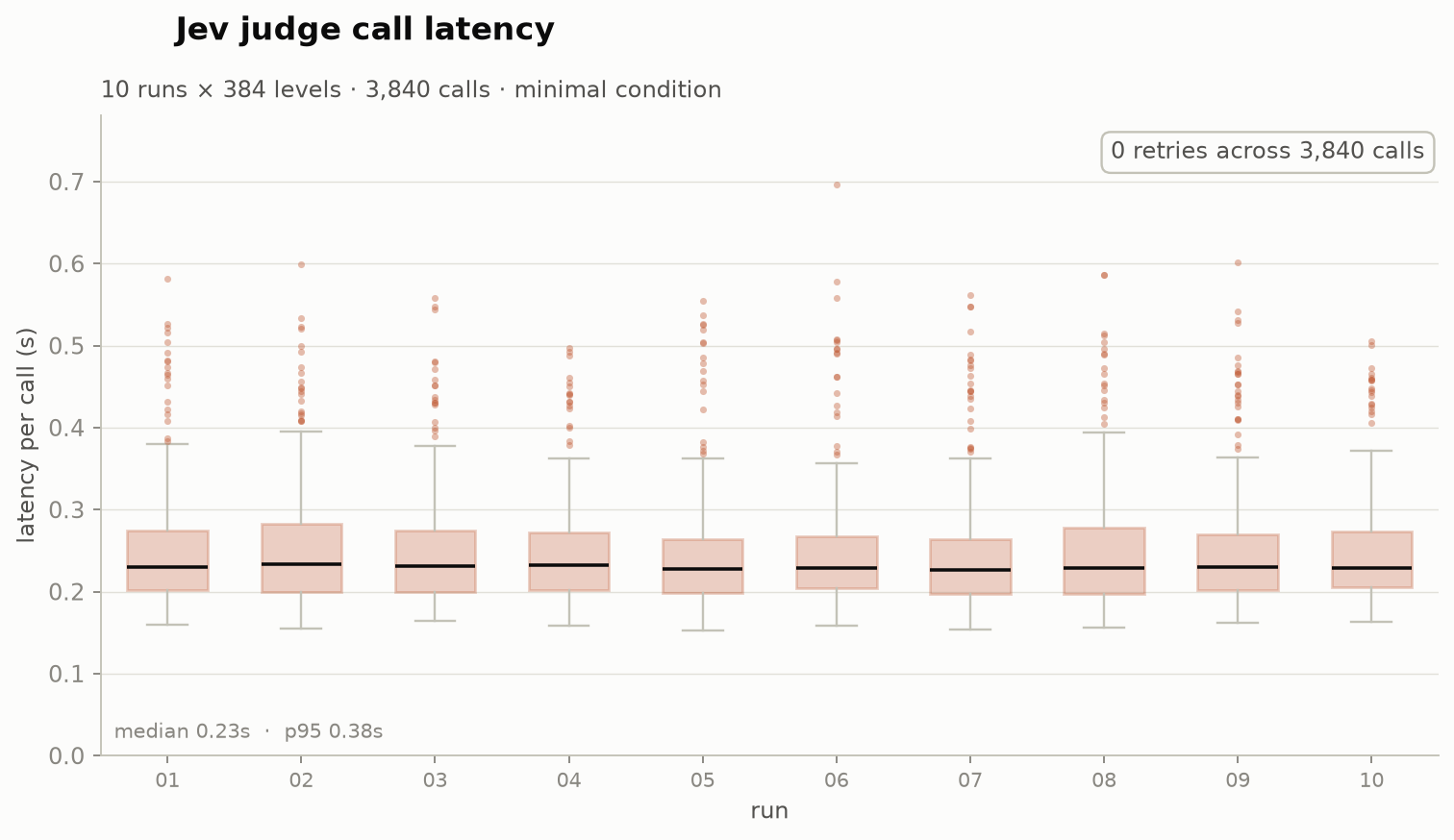
This is calling from my laptop on the East Coast. I’d love to get numbers with more favorable regional colocation and networking.
I spent $0.56 on the 5,866 requests I made in this test and related probing. That’s about a hundredth of a cent per call.
Scope and limits
One dataset, one domain, and one I built myself to stress exactly this kind of interdependency. The results are specific to my example. YMMV.
The comparison is against a Haiku judge, not ground truth, and where they disagreed I adjudicated the cases myself. The original judgments also have the problems I wrote about in a number that looks fine.
All timings are from my laptop on the East Coast, against jev-1.13. I expect things will change rapidly.
Run it yourself: repo